
Now Reading: Script School Lesson 5: Narrative Structure Explained, Linear vs Non-Linear vs Circular vs Parallel (Kahani Kaise Sunayein)
- 01
Script School Lesson 5: Narrative Structure Explained, Linear vs Non-Linear vs Circular vs Parallel (Kahani Kaise Sunayein)

Script School Lesson 5: Narrative Structure Explained, Linear vs Non-Linear vs Circular vs Parallel (Kahani Kaise Sunayein)

Quick answer: Narrative structure is the order in which a film shows you its events. There are four common types: linear (in order, start to end), non-linear (it jumps back and forth, usually with flashbacks), circular (it ends where it began) and parallel (two stories told side by side). The story is the same; only the order you see it in changes, and that order decides what you feel.
| Lesson | 5 of the free Script School series |
| You will learn | the 4 story orders, what each does to the viewer, and how to choose |
| Time | about 7 minutes to read + 10-minute exercise |
| Before this | Lesson 4: three-act structure |
Start with a wedding story
Your cousin’s wedding had a big fight at the end. When you tell a friend about it, you have a choice. You can start in the morning and go hour by hour. You can start with “there was a huge fight!” and then go back to explain how it started. You can start and finish at the same moment, the fight, with the whole day in between. Or you can tell your story and your sister’s story of the same day, one bit each, turn by turn.
Same day, same facts, four very different experiences for the listener. That choice is what writers call narrative structure = the order in which the audience is shown the events. The real order of events is the story; the order on screen is the telling.
The 4 types, one by one
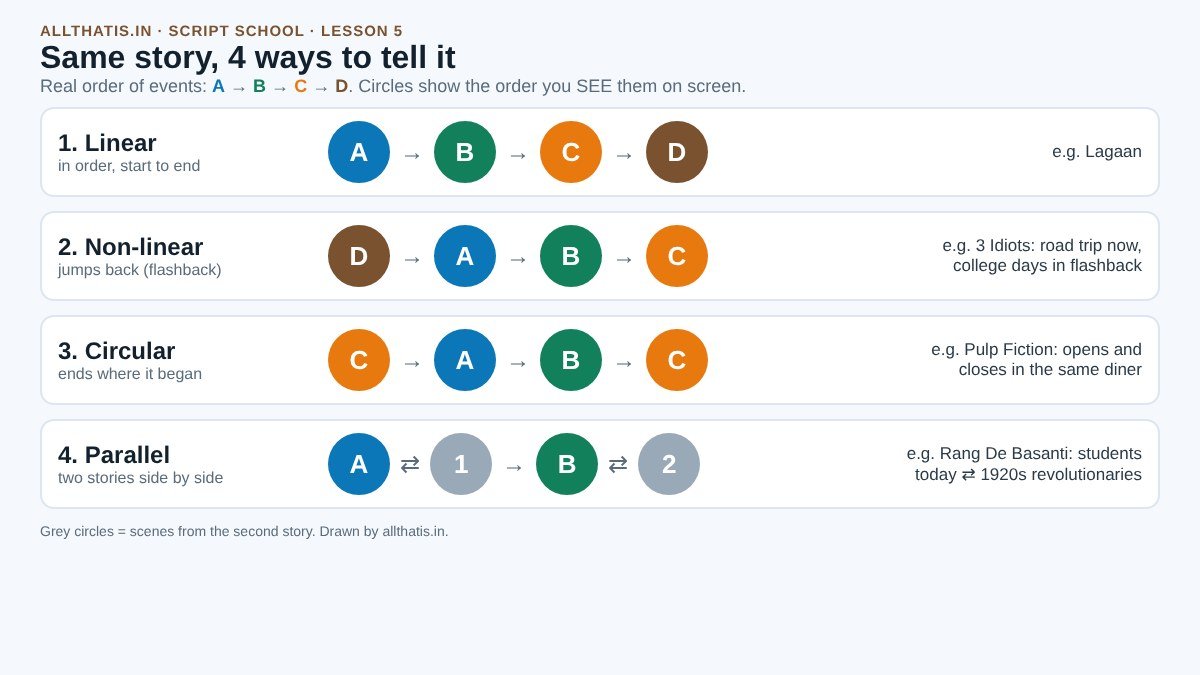
1. Linear: in order, start to end
Events come in the order they happened. Lagaan is a good example: the tax, the bet, the training and the match follow each other in time. What it does to you: you live the story with the hero, step by step, so the tension builds naturally. It is the easiest structure to follow, which is why most films use it.
2. Non-linear: jumps back and forth
The film shows you a later moment first and then fills in the past, usually with flashbacks (= scenes from earlier in time). 3 Idiots follows Farhan and Raju on a road trip in the present to find Rancho, and their college days come back in flashbacks. What it does to you: it creates questions (“what happened to Rancho?”) that keep you watching. Thrillers like Drishyam use the same tool in a sharper way: a key scene from the past is shown only near the end, and it changes the meaning of everything you saw.
3. Circular: ends where it began
The film opens with a moment, goes back to show how we got there, and returns to the same moment at the end, which now feels different because you know more. Pulp Fiction (1994) opens and closes in the same diner. What it does to you: the ending feels complete, like a loop closing, and the first scene gains a new meaning on the second look.
4. Parallel: two stories side by side
Two stories, often in different times or places, are cut together so each one comments on the other. In Rang De Basanti, college students act in a film about 1920s revolutionaries, and the two stories run side by side until the students start to live what they are acting. What it does to you: you see the link between the two stories before the characters do, which gives the ending its punch.
How the order changes the feeling, in 3 steps
- Step 1: every scene answers some questions and raises others.
- Step 2 (the key step): changing the order changes which questions are in your head while you watch. Show the fight first, and you watch the morning asking “how did it come to this?”. Show the morning first, and you watch it relaxed.
- So: the writer picks the order that keeps the most useful question in your head for the longest time.
The one contrast to remember: in a linear film you ask “what happens next?”; in a non-linear film you ask “how did this happen?”. Both keep you watching, but they pull on different kinds of curiosity.
What is true, and what people often get wrong
A common belief is that non-linear films are “smarter” than linear ones. That is not true. Structure is a tool, not a grade. A jumbled order without a reason only confuses people; a simple linear film like Lagaan can grip a whole country. The right question is always: which order makes this particular story hit hardest?
A check you can do yourself
Next time you watch a film, note down the first scene. At the end, ask: when did that first scene really happen in the story? If it happened at the start, the film is probably linear. If it happened near the end, the film is non-linear or circular.
Your turn (10 minutes)
- Take the story you built in Lessons 1–4 (or any real event from your week).
- Write its 4 main moments as A, B, C, D in the order they happened.
- Now write it twice more: once starting with D (non-linear), once starting and ending with C (circular).
- Read all three versions. Which one makes you most curious? That is the order to use.
The one-line takeaway: the story is what happened; the structure is the order you choose to show it, and that order decides what the audience feels.
Next, Lesson 6: beats, the smaller steps inside each act.
All lessons: Lesson 1: what makes a story · Lesson 2: logline · Lesson 3: a hero people care about · Lesson 4: three-act structure · Lesson 5: narrative structure · 12 storytelling techniques · Script School home
Words on this page: narrative structure = the order the audience sees events in · flashback = a scene from earlier in time · linear = in time order · parallel = two stories cut together · more screenplay terms
Script School is free. Questions? Tell us through our contact page.