
Now Reading: Script School Lesson 4: Three-Act Structure Explained Simply (Kahani Ka Dhaancha)
- 01
Script School Lesson 4: Three-Act Structure Explained Simply (Kahani Ka Dhaancha)

Script School Lesson 4: Three-Act Structure Explained Simply (Kahani Ka Dhaancha)

Quick answer: Three-act structure means a story has a beginning (Act 1: we meet the hero and the problem arrives), a middle (Act 2: the hero struggles and things get worse) and an end (Act 3: the big final fight or decision, and what changes). Act 1 and Act 3 are each about a quarter of the film; Act 2 is about half. It is not a rule from a rulebook; it is the shape most films people enjoy already have.
| Lesson | 4 of the free Script School series |
| You will learn | the three acts, five key moments, and how the Indian interval fits in |
| Time | about 8 minutes to read + 10-minute exercise |
| Before this | Lesson 3: a hero people care about |
The three acts in one line each
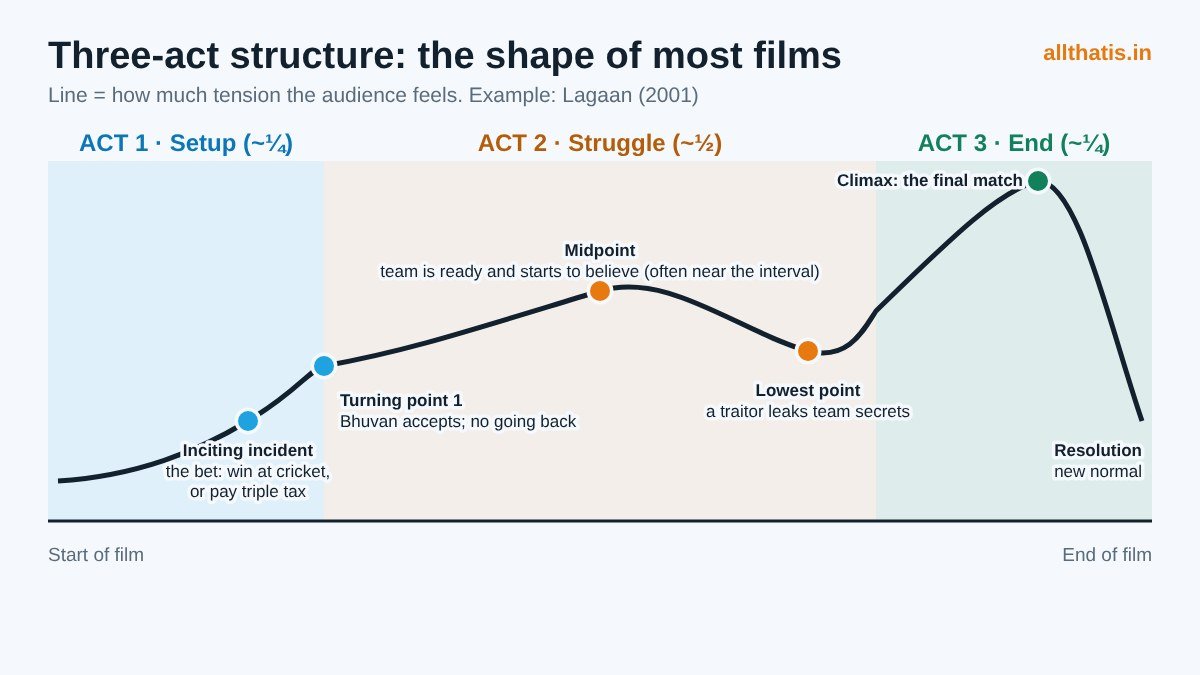
- Act 1, Setup (first ~25%): show the hero’s normal life and what they want. Then something breaks that normal life.
- Act 2, Struggle (middle ~50%): the hero tries, fails, learns and tries again. Each obstacle is bigger than the last.
- Act 3, End (last ~25%): the biggest test. The hero wins or loses, and we see the new normal.
Five moments that hold the shape
Think of these as pillars. Most of the story hangs between them.
- 1. Inciting incident: the event that disturbs normal life and starts the story. It should happen to the hero, not just near them.
- 2. Turning point 1 (end of Act 1): the hero makes a choice they cannot take back. Now the journey truly begins.
- 3. Midpoint: something changes the game in the middle: a big win, a big reveal, or the stakes go up.
- 4. Lowest point (end of Act 2): everything looks lost. This is where the hero’s flaw from Lesson 3 usually hurts most.
- 5. Climax (Act 3): the final test, where the hero must use what they learned.
See it in a film you know: Lagaan (2001)
Here is how Lagaan fits the shape. Describing it in our own words, without the full plot:
- Normal life: a drought-hit village struggles to pay land tax (lagaan) to the British.
- Inciting incident: a British officer offers a bet: beat his team at cricket and the tax is cancelled for three years; lose and the village pays three times the tax.
- Turning point 1: Bhuvan accepts the bet for the whole village. There is no way back.
- Act 2: he must build a team from villagers who have never played, win people over, and learn the game. The team grows, and so does hope (midpoint feeling).
- Lowest point: a member of the team secretly works against them, and the match starts badly.
- Climax: the final match itself, which decides everything.
- Resolution: the result changes the village’s life.
Where does the Indian interval fit?
Most Indian films have an interval. Writers often place a strong twist or a big decision just before it, so people come back excited after the break. In many films that “interval block” sits close to the midpoint of Act 2. So a simple way to plan an Indian film is: Act 1 + first half of Act 2 before the interval, the rest after. This is a common habit, not a rule; some films put the interval elsewhere.
Common mistakes
- Act 1 is too long: the audience waits too long for the story to start.
- Act 2 has no rising obstacles: the middle feels flat (“second half was slow” is a common review line).
- The climax is solved by luck or someone else: the hero must act.
- No lowest point: if things never look lost, the win does not feel earned.
Your turn (10 minutes)
- Take the hero from Lessons 2 and 3.
- Write one line for each of the five moments: inciting incident, turning point 1, midpoint, lowest point, climax.
- Check: does each moment make things harder or bigger than the one before? If two feel the same size, change one.
- Bonus: mark where your interval would go and write the one line that makes people come back after it.
Next, Lesson 5: beats, the smaller steps inside each act.
All lessons: Lesson 1: what makes a story · Lesson 2: logline · Lesson 3: a hero people care about · Lesson 4: three-act structure · 12 storytelling techniques · Script School home
Words on this page: act = a big section of a story · inciting incident = the event that starts the story · climax = the biggest, final test · resolution = what life looks like after · more screenplay terms
Script School is free. Questions? Tell us through our contact page.