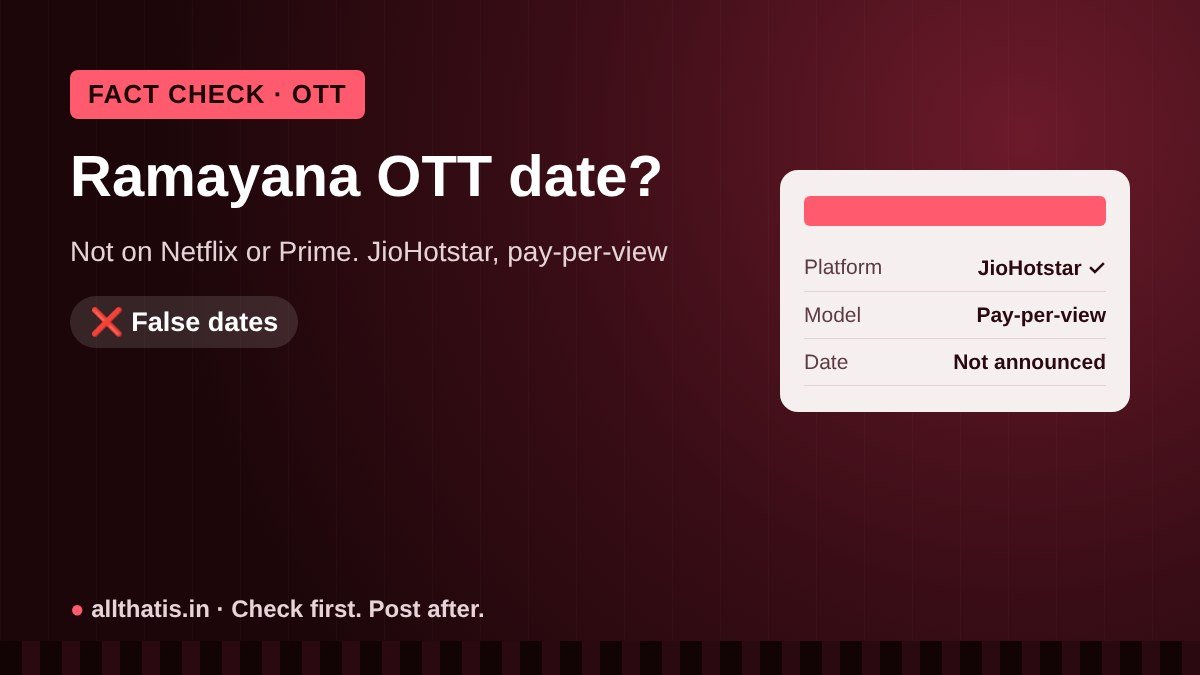

Now Reading: Fact Check: Has Ramayana Crossed ₹1,000 Crore and Recovered Its Budget? (Sach Ya Jhooth)
- 01
Fact Check: Has Ramayana Crossed ₹1,000 Crore and Recovered Its Budget? (Sach Ya Jhooth)

Fact Check: Has Ramayana Crossed ₹1,000 Crore and Recovered Its Budget? (Sach Ya Jhooth)

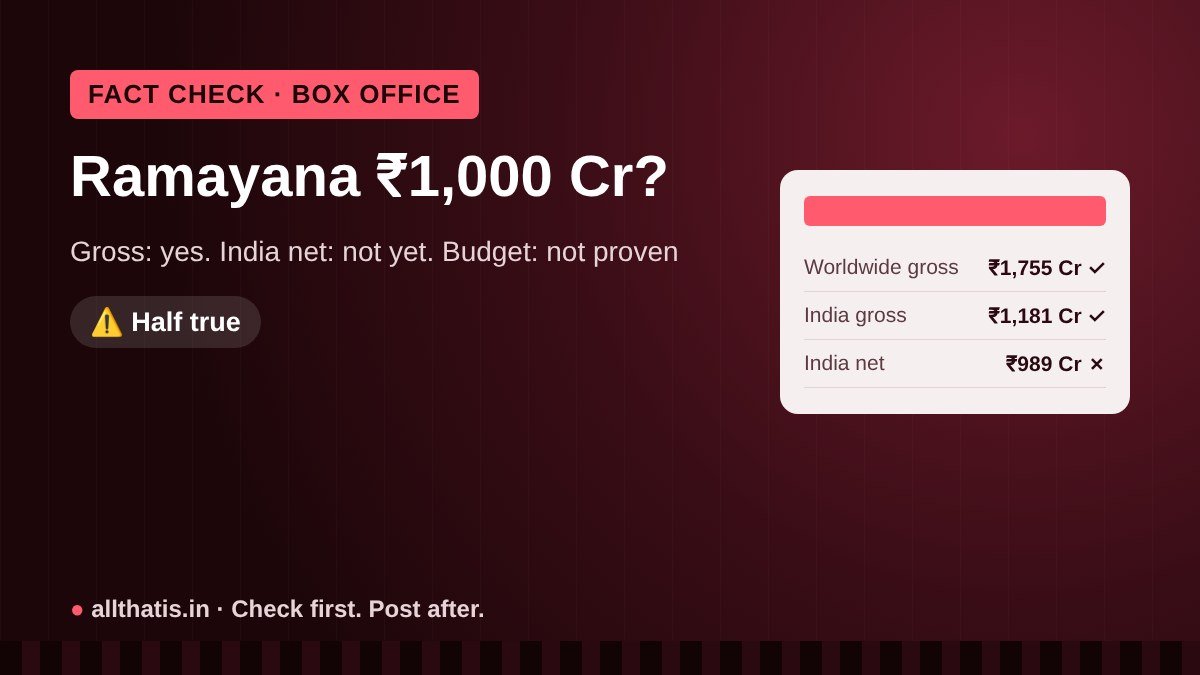
Ramayana is past ₹1,000 crore in gross, but India net was ₹989 crore after 22 days. Budget recovered? Not proven. Gross vs net explained simply.
Quick answer: “Ramayana has crossed ₹1,000 crore” is half true. Its worldwide gross (about ₹1,755 crore) and India gross (about ₹1,181 crore) are well past ₹1,000 crore. But its India net, the number most trade posts use for “clubs”, was about ₹989 crore after 22 days, so not there yet on 26 Nov. And “it has already recovered its budget” is not proven: the makers have not shared a Part 1 budget.
| Verdicts | ❌ False = proven wrong on record · ⚠️ Misleading / Half true / Not proven = part true, told wrongly, or no proof yet · ✅ True = confirmed on record |
| Last checked | 26 Nov 2026, 11:45 PM IST |
How we fact check: we only check claims that are already being shared, and we only use on-record proof (the makers’ or platform’s own words, an official post, a professional fact-checker, or two reliable reports). If we cannot check a claim, we say so. We do not touch rumours about anyone’s personal life. More fact checks.
1. “Ramayana has crossed ₹1,000 crore”
Verdict: ⚠️ Half true (true for gross, not yet for India net)
What spread: posts and headlines saying Ramayana has “entered the ₹1,000 crore club”, while other headlines on the same day said it is “near ₹1,000 crore”. Both can be found, which is why people are confused.
The truth: they are talking about three different numbers. Here they are, from Sacnilk’s tracking as reported on 26 Nov 2026:
| Which number | Ramayana: Part 1 | Crossed ₹1,000 crore? |
|---|---|---|
| Worldwide gross (India + overseas, with tax) | ₹1,755.50 crore (through Day 21) | ✅ Above ₹1,000 crore |
| India gross (India tickets, with tax) | ₹1,181.64 crore (Day 22) | ✅ Above ₹1,000 crore |
| India net (India tickets, tax removed) | ₹989.35 crore (Day 22, live) | ❌ Not yet, about ₹11 crore short |
So a post saying “₹1,000 crore” is right if it means gross, and wrong if it means India net. The film released on 5 Nov 2026. These are trade estimates; there is no official box office body in India, so different trackers show slightly different numbers (why the numbers differ).
2. “Ramayana has already recovered its budget”
Verdict: ⚠️ Not proven
What spread: filmmaker Ram Gopal Varma posted on X that Part 1 cost “a little less than 800” crore, so people concluded the film is already in profit.
The truth: the only budget the producer has given is ₹4,000 crore for both parts together (Part 1 + Part 2), stated by Namit Malhotra in interviews. He has not said how much Part 1 alone cost, and nobody from the film has replied to the ₹800 crore claim (Koimoi fact check, 18 Nov 2026). Without a Part 1 budget, nobody can honestly say it has “recovered” it.
Why the confusion happens (explained simply)
Think of a ₹100 box of sweets. You pay ₹100 (that is the gross). Part of it is tax that goes to the government; what is left is the net. Then the shop keeps its cut, and only the rest reaches the sweet-maker. A film works the same way:
- Step 1 — Gross: all the ticket money people paid, including GST.
- Step 2 — Net: gross minus GST. For Ramayana, India gross ₹1,181.64 crore became India net ₹989.35 crore — about ₹192 crore went to tax.
- Step 3 — Share: the theatre keeps its share of the net, and only the rest goes to the distributor and producer. So even India net is not money in the producer’s pocket.
The one line that clears it: “₹1,000 crore gross” and “₹1,000 crore net” are two different milestones, and neither one is the producer’s profit. That is why “budget recovered” needs the real budget and the producer’s share, and we have neither on record.
Words used: gross, net and distributor share explained.
How to check this yourself
- When you see “₹1,000 crore”, look for the small word next to it: gross, net, India or worldwide. No word = treat it carefully.
- Match the day: Day 13 and Day 22 numbers are both “true” but for different dates.
- For “hit” or “profit” claims, ask: did the makers say the budget for this part? If not, it is a guess.
Questions people ask
Has Ramayana crossed ₹1,000 crore?
Yes in worldwide gross and India gross. In India net it was about ₹989 crore after 22 days (26 Nov 2026), so not yet.
What is the budget of Ramayana Part 1?
Not officially announced. The producer has only said ₹4,000 crore for both parts together. The ₹800 crore figure for Part 1 is Ram Gopal Varma’s claim, not confirmed by the makers.
Is Ramayana a hit or flop?
Its collections are among the biggest for an Indian film, but a hit/flop verdict needs the cost and the producer’s share. Those are not on record, so any verdict today is an opinion.
Track it day by day: Ramayana box office collection, day wise.
Seen a viral film claim?
Send it through our contact page with a link or screenshot. If it is about a film, an OTT date, a box office number or something a star said about their work, we will check it.
Sources
- ETV Bharat (Sacnilk figures): Day 22 — ₹989.35 cr India net, ₹1,181.64 cr India gross, 26 Nov 2026
- Sacnilk: Ramayana live box office page
- Business Upturn (Sacnilk figures): Day 20 — ₹972.95 cr India net, 25 Nov 2026
- Koimoi fact check: Has Ramayana recovered its budget? (18 Nov 2026)
Spotted a mistake or a change? Tell us through our contact page. How we work.